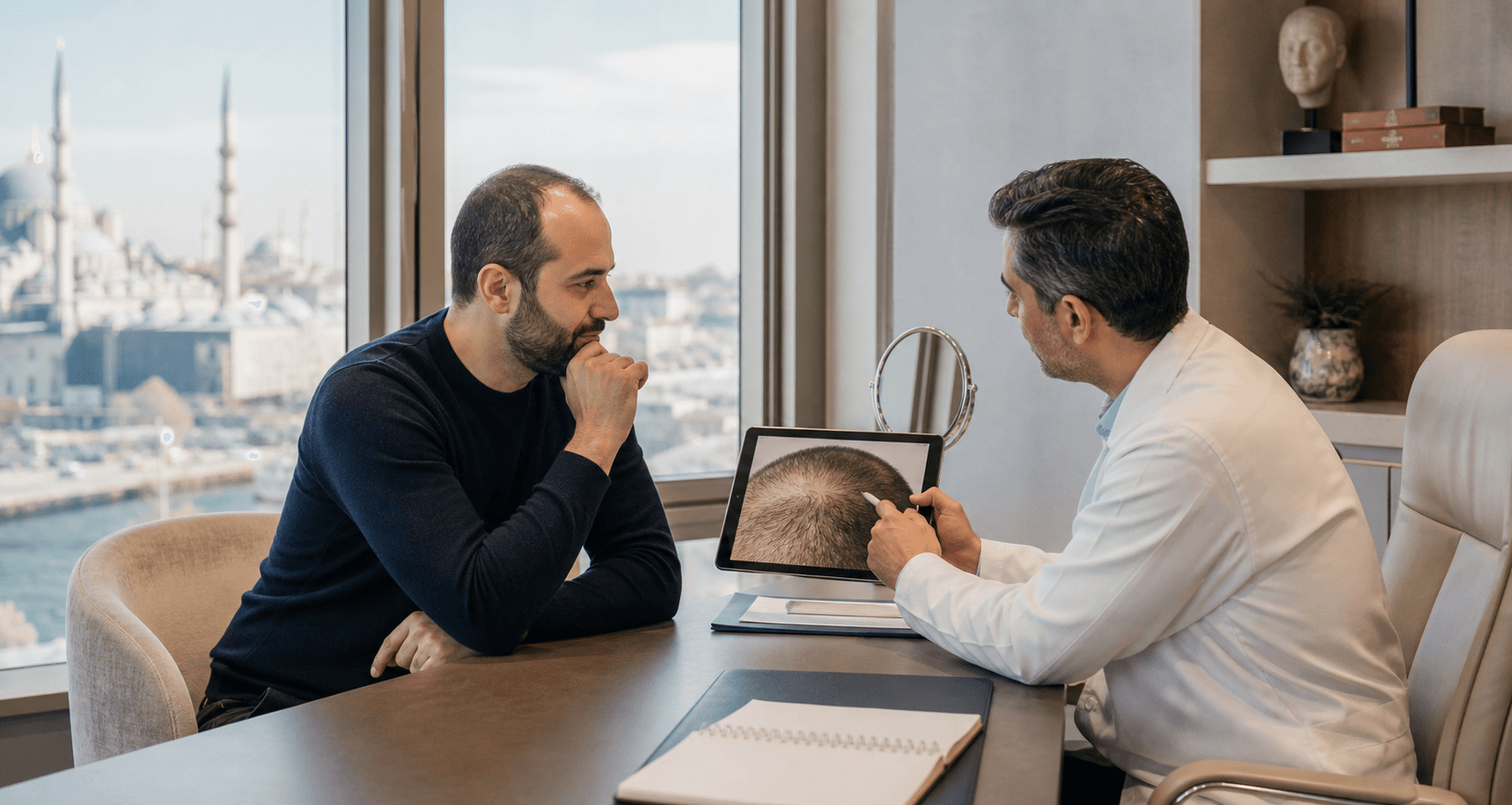
What patients often discover too late
The biggest gap between marketing and reality is not usually the airport pickup or the hotel. It is the medical detail. Many hair transplant clinics advertise very clean package pricing, but patients often arrive without fully understanding who the surgeon is, how involved that surgeon will be, or whether the quoted graft count is even realistic for their scalp and donor area.
This matters because hair transplantation is easy to market as a routine travel purchase, even though the result can affect your appearance for years. A rushed hairline design, poor graft handling, or aggressive overharvesting can leave lasting problems that are much harder to fix than the original hair loss.
The honest version is that Turkey has both excellent and weak options in the same market. Quality varies significantly between clinics, which is why a patient-centered process matters more than a polished Instagram page. Readers comparing quotes at the same time should also look at Turkey Hair Transplant Cost Breakdown: What's Actually Included?.
Why patients consider Turkey for hair transplants
Patients usually look at Turkey because it combines lower treatment costs with an unusually mature international patient ecosystem. Istanbul especially has high clinic density, experienced operators, and a travel system built around airport pickup, short-stay packages, and fast turnaround.
That does not automatically make every option good. It does explain why Turkey remains one of the first places people research when they start comparing FUE, DHI, or beard-to-scalp restoration options abroad.
- Pricing is often much lower than self-pay treatment in the U.S., Canada, or the U.K.
- Many clinics have large case volume and dedicated international coordination teams
- Travel logistics are usually easier than patients expect once transfers and hotel stays are organized
What clinics often leave out of the sales conversation
The phrase 'all-inclusive package' sounds reassuring, but it often focuses on travel convenience rather than medical transparency. The better question is not whether the package includes a hotel. It is whether the package explains the treatment plan clearly enough for you to consent properly.
Who actually performs the key steps
In many clinics, technicians handle a significant part of the day. That is not automatically a problem, because strong technicians are common in hair restoration. The issue is when patients are led to believe the named doctor will personally do almost everything when that is not how the clinic operates.
You should ask who designs the hairline, who administers anesthesia, who extracts grafts, who opens recipient channels, and who places grafts. Those are not small details. They shape the result.
Whether the graft count is realistic
Advertised graft numbers can be misleading. A quote for 4,500 or 5,000 grafts may sound impressive, but your scalp laxity, donor density, hair characteristics, and long-term hair loss pattern determine what is actually sensible. More is not always better if the donor area is being pushed too hard.
How much planning is being done for future hair loss
A hair transplant is not just about filling today's frontal gap. Younger patients especially need a strategy that still makes sense if native hair continues to thin over the next five or ten years. Clinics that focus only on a dramatic hairline for social media may not be protecting the future picture well.
Hair transplant cost ranges and what is usually included
As of May 2026, many international patients see Turkey hair transplant quotes roughly around $2,000 to $5,500 for common FUE or DHI packages, with premium clinics, larger sessions, or more physician-led models sometimes running higher. Some bargain offers sit below that range, but very low pricing should slow you down rather than speed you up.
Many packages include consultation, blood tests, the procedure day, medication starter kits, aftercare washing instructions, one or two nights of hotel, and local transfers. Flights are often excluded. Extra PRP, sedation, additional nights, or a second touch-up day may be extra.
- Common included items: procedure, transfers, hotel, translator support, first wash, aftercare kit
- Common exclusions: flights, extended stay, companion expenses, future medication, corrective work
- Common hidden variable: whether the quote is based on a fixed package rather than a case-specific medical plan
Recovery timeline patients should plan for
Recovery is usually manageable, but it is still a medical trip, not a quick city break. The first ten days shape how cleanly the grafts settle and how comfortable the return journey feels.
First 72 hours
Expect scalp tenderness, swelling around the forehead in some patients, and a noticeable need to protect the recipient area from friction. Sleeping elevated is common advice. Most patients are functional, but they do not feel fully normal.
Days 4 to 10
Scabbing and redness are common. Clinics often schedule the first wash during this window. Many patients are comfortable flying home by then, but you still need to follow washing and sun-exposure instructions carefully.
Weeks 2 to 12
Transplanted hairs commonly shed before regrowth begins. That shedding can be emotionally stressful if you were not warned about it. Visible growth usually starts gradually after a few months, while fuller cosmetic maturation often takes 9 to 12 months and sometimes longer.
Risks and what patients should watch out for
Hair transplants are often marketed as low drama, but there are real risks. Infection is uncommon but possible. Poor growth, unnatural hairline design, patchy density, shock loss, and donor overharvesting are the problems that patients talk about most often in forums.
The risk that matters most in practice is not usually a dramatic medical emergency. It is a mediocre or obviously artificial result that becomes expensive and emotionally draining to repair. That is why the quality of planning matters so much.
- Unnatural hairline shape or placement
- Overharvested donor area that looks thin or moth-eaten
- Lower-than-expected growth due to poor graft handling
- Under-discussed long-term maintenance needs if native hair keeps thinning
10 questions to ask before choosing a clinic
A strong clinic should be comfortable answering direct questions without getting defensive. If you feel rushed toward a deposit before basic questions are answered, take that seriously.
- Who designs my hairline and who performs each technical step of the procedure?
- How many patients are being treated on the same day as me?
- What graft count do you think is realistic for my donor area and why?
- What happens if my native hair keeps receding after this procedure?
- Can I see before-and-after cases with similar hair loss and similar hair texture?
- What is included in the quote, and what costs extra?
- How many days should I stay in Turkey before flying home?
- What does aftercare look like once I return home?
- If I am unhappy with growth, what follow-up or correction policy exists?
- What are the main reasons you would advise me to delay or avoid surgery right now?
The bottom line
Turkey can be a very good place to have a hair transplant, but only if you approach it as a medical decision instead of a travel deal. Price matters, but it should sit behind surgeon oversight, realistic planning, donor management, and aftercare clarity.
Mirava Med's role is to help patients compare clinics more calmly, ask stronger questions, and avoid getting pushed into a package that looks convenient on paper but leaves too many important details unclear.
FAQ
Are hair transplants in Turkey actually safe?
They can be, but safety depends much more on the individual clinic and the people running your case than on the country label alone. Turkey has excellent clinics and weak clinics in the same market.
The safest approach is to verify surgeon involvement, ask for case examples similar to yours, and make sure the clinic is discussing risks and limitations rather than only package perks.
How long do I need to stay in Turkey for a hair transplant?
Many patients stay about 3 to 5 nights, depending on arrival timing, the first wash schedule, and how comfortable the clinic is with clearing you to fly. Some premium clinics may keep the process tighter, while more cautious planning may add an extra night.
Is DHI better than FUE?
Not automatically. Both terms are often used as marketing shorthand. The better question is whether the clinic has a sensible plan for your hair characteristics, graft handling, and density goals.
What is the biggest red flag?
A clinic that gives you a very aggressive graft promise and a discount deadline before properly discussing donor limitations, future hair loss, and who will actually perform the core parts of the procedure is a major warning sign.
Related reading
Useful for readers who want to move from marketing claims to itemized package details.
Natural next step for readers who are already collecting quotes and want a screening checklist.
Helps readers understand the broader travel and coordination process around treatment trips.